
Like everyone else, I have big dreams. But for me, the moment an idea sparks, it doesn’t just stay a thought—it becomes a full-blown empire. Give me a small idea and watch me picture the potential and the possibilities. Watch me turn my newfound hobby into my bread-winning career. My conviction and desire to achieve this new reality create deep roots and anything else becomes blurry, unimportant. The Dream is all I can think about. I become obsessed with it. I sit down to draw the roadmap to my success. I break down the actions I need to take to achieve such goal and figure out how much time I need, and what tools I will require to get that in place. I know what I need to do, what steps to take to make my Dream become reality. I am all set. I’m ready. But if that is the case, then why do I always give up on my goals?
The start comes strong and I can keep the hype for a day, a week, a month even if I’m really committed. And then I stop. The goal and the plan stay forgotten. I give up on them. Not because they are not good or well thought out. But because there is such a fight inside of me to keep me “safe” where I’m at. The entirety of the plan becomes overwhelming. I mean, I just created this whole life or world in my mind in seconds, minutes. And I want to achieve these goals just as quickly as I imagined it. That is what I call being delusional. Have you ever gone through the same pattern? And how do you feel about yourself once you “move on” to the next dream? I don’t know about you, but I feel disappointed and frustrated, just to begin with. Every single time.
Why Do I Give Up on My Goals? The Data
It gives me some peace of mind knowing I am not alone. A research done by Forbes in 2023 showed that the American Average New Year’s Resolution lasts just 3.74 months. Only 6% of the interviewed were still sticking to their resolution after a year. Interestingly enough is to know that, unofficially Quitter’s Day happens on the second Friday of January, while Ditch New Year’s Resolutions Day is celebrated on January 17th. That being said, June 1st is also unofficially, considered New Year’s Resolution Recommitment Day. These numbers say a lot.
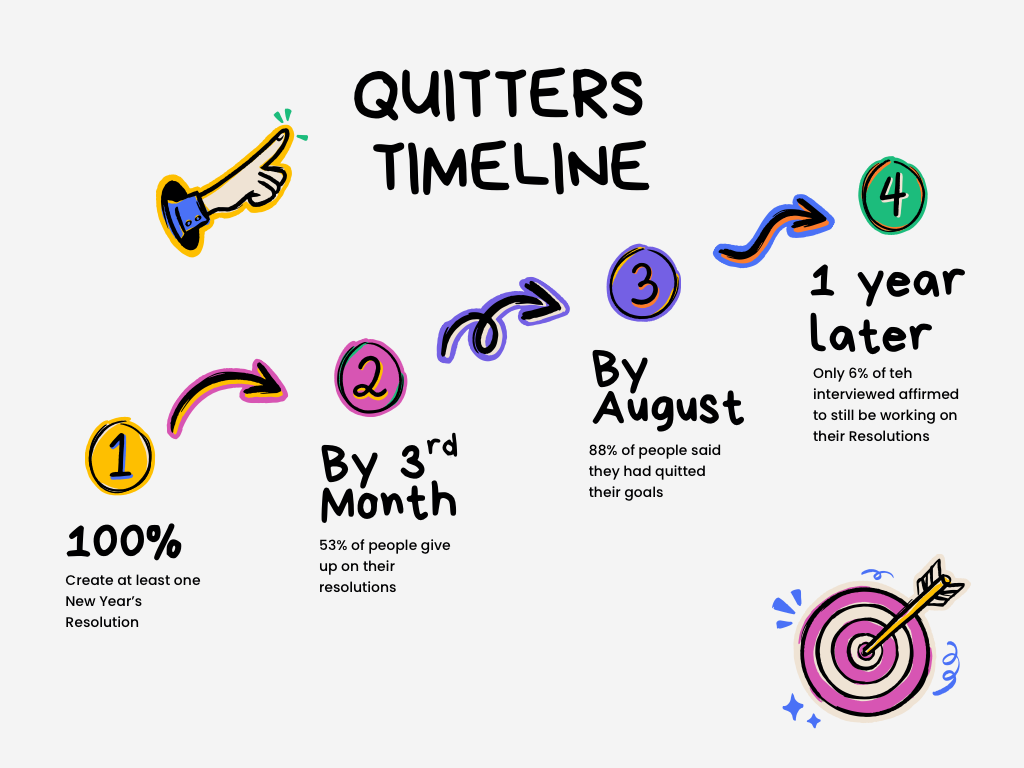
As you can see in the data below, the drop-off happens fast. But it begs a deeper question: What are resolutions and goals anyways? Why do we create them and why do we need them? I think we can all agree that goals are a long-term outcome that we want to achieve. The Dream. We set the direction we want to take, the life we want to have, the person we want to become, and then fill the gap between our reality today and the achievement of said goal with objectives – specific and measurable short-term actions.
There are great advantages of goal setting. It can support our mental health, especially when we achieve them. It gives us a sense of purpose and direction. We know where to focus our energy. It helps us make a map of our path towards our destination, keeping us on track when we start deviating from our path. When we feel lost, we can come back to that map we created and find our way again. If only it was that simple.
Why Traditional Goal Setting Fails Us
If we research about goals, we will be inundated with content trying to assist us on setting big and bold, but achievable goals. These goals need to challenge us but remain realistic. Some will say that these goals should be ambitious, or even on the borderline of delusion. But they all agree that we should never set goals that are small and that limit ourselves to our comfort zone. These goals are here to elevate and help us grow. Many are the tools available to help us set these goals and create the roadmap towards our Dreams. Most of us heard of and used the S.M.A.R.T. Goal setting strategy before. Specific, Measurable, Achievable, Relevant, and Time-Bound. Other tools are related to define the specific monthly and weekly objectives, daily tasks to be done. Build an timeline, use planners, calendars. Paper or online version. Take your pick.
This is where breaking the goals into smaller achievable actions comes in play. We can do that, right? For me, it sounds like a promising solution to my overwhelming issue. Breakdown these humongous project into bite sized tasks. They are much easier to digest, and the mind doesn’t see them as threatening. What if we suddenly decide to run a half-marathon in six months when we don’t even go on walks? First task is to buy running shoes. Then walk around the block. Move on to walking two miles, then five miles. Soon we are running a mile, and then five miles. And so on until we find ourselves prepared to run a half marathon. See? Much more realistic than start running it all from day one.
I feel like I am only stating the obvious here. But am I? If it was that simple I would have achieved so many goals I set to myself throughout the years. And so would have all those that were interviewed abut their New Year’s resolution. I’ve been focused, motivated, and I used the tools. If you are still reading this, I’m assuming that, just like me, you were not able to achieve most of the goals you’ve set.
Maybe we weren’t motivated enough. Maybe we didn’t have the right tools needed to bring our ideas into fruition. Maybe we weren’t clear enough with what our goal was. Maybe we were reaching for the wrong goals, ones that didn’t align with what we deep down wanted, and that was why we sabotaged ourselves. What if the goal we set was so much bigger than what we were ever capable to reach for? Our luck, the universe, those around us were working against us. The list of reasons or excuses is extensive. We must be doing something wrong or missing some important piece of information! That’s how I feel.
At this point we start doubting ourselves. We get frustrated, sad, angry, disappointed. And we end up giving up on that dream, if we haven’t already. That beautiful, incredible dream. We suffer and mourn the loss of something we never had to begin with. I find myself constantly thinking “what the hell is wrong with me?”. Why can’t I follow through with my ideas and goals? What if I was smarter? What if I was better connected? What if I had done “x” instead of “y”? Why, why ,why. What if, what if, what if.
Of course that are times that we, consciously, decide to move on from a goal after thoughtful consideration. At least I hope this decision was made for the best. Life circumstances may takes us into different directions. A better, bigger opportunity may arise. And there is nothing wrong with retiring an idea in favor of pursuing a new goal. It doesn’t mean all those feelings of failure will not manifest themselves. We might still feel like quitters. At what point do we distinguish moving on towards something better and being quitters? How do we accept that that was the right decision? How do we even know if that was the right thing to do?
I cannot pretend to hold all the answers. Although I have a million and one questions (that might never get answered), as you may have noticed. I have been working hard to answer some of these conundrums. Through therapy, coaching sessions, reading self development books, listening to podcasts, so on and so forth. Some of the answers got answered, but many more took their place. It hasn’t been an easy, nor quick process, but definitely rewarding.
One thing I learned is how much of my non success is due to fear. Fear of so many things. Fear of being judged, of disappointing others, of doing it wrong, of failing. Much has to do with my “Defectiveness/Shame schema”. Psychologist Jeffrey Young, developed the Schema Therapy, which explains that schemas are self-defeating, core themes and patterns of thoughts and behaviours developed during childhood or adolescence, that keep repeating throughout our lives. The concept for the Defectiveness/Shame schema refers to a profound belief of being inadequate, flawed, inferior and the belief that those around me will reject me once they know the real me. Many of the thoughts that block my advancement are thoughts questioning my capabilities and validity to achieve my goals. Each one of us will, most likely, have our own set of schemas and limiting beliefs, and they can be very different. But they are just as deterrent.
But schemas are only part of the equation. As I dug deeper into why we stall, I stumbled upon an unexpected explanation from a completely different realm: Quantum Physics. Hear me out.
The Quantum Physics of Goal Setting
In Classical Physics (the one we learned at school, or, at least in my case, tried to), the one that follows Isaac Newtons “teachings“, particles – the building blocks of all matter – follow certain predictable rules. Rule N# 1 – “Definite Position”: A particle is always in one specific place at one specific time. Rule N# 2 – “Predictable Path”: If you can tell where a particle was at a certain moment, you are able to predict, with certainty, the path from which it came from and the exact path it is going to follow. Rule N# 3 – Matter and Waves: In the macro physical world a rock is a rock (it is matter) and a ripple in a pond is a ripple (a wave). A rock cannot turn into a wave.
In contrast, Quantum Physics (QP) research the behaviour of the world of the subatomic particles, the even smaller parts that make up a particle. We are talking about electrons or photons. Once you look into these elements, the rules of Classical Physics break down. The particles are now in a world of “clouds of possibilities”. What this means is that the established set of rules no longer apply.
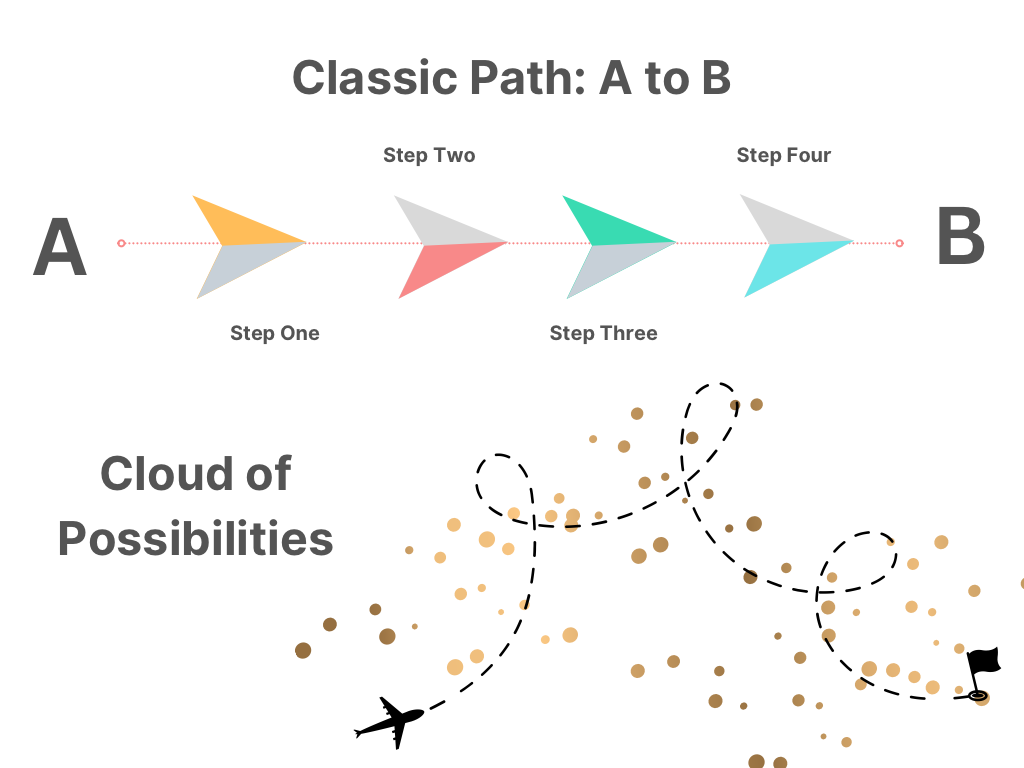
In QP, there is a concept called Superposition that explains that a quantum particle doesn’t exist in only one spot. Until we measure or observe it, the particle spreads like a wave and exists in all possible locations at the same time. A particle also have a dual nature. When travelling through space it behaves like a wave but as soon we try to observe or measure them, they “collapse” and start behaving like a regular particle. In QP it is also impossible to predict where a quantum particle will be. We can only calculate the odds of where it may show up.
What does all of that have to do with goal setting and achieving our Dreams? I’ll explain through three of Quantum Physics concepts and how they apply to what we’ve been talking about.
The Observer Effect and the Energy of Scarcity.
Once we observe a particle, it’s wave of possibilities “collapse” into a single position. Once we create a Dream, we observe our current reality, which means we are focusing on the absence of that goal. The gap between where we are and where we want to be. The probability “colapses” into the gap. We can only focus on how far we are from the goal, all the things we don’t have and all the things we have not achieved. All that is missing.
The Quantum Zeno Effect & Goal Micromanagement
In QP this effect states that an unstable quantum system can be “frozen” in its initial state if measured too much and too fast. How many times have we kept looking at the water, waiting for it to boil so we could continue with our cooking, and it just wouldn’t until we stopped observing it? When we create such a detailed path, with constant measurements of its progress, we end up micromanaging the goal. Checking our progress (or lack thereof) causes us to question it all: “why isn’t it working?”, “what am I doing wrong?”. We end up freezing the progress in the unfulfilled state. We block the natural flow of possibilities.
Superposition & Blocking Infinite Potential
Before we observe a quantum particle, it exists in all possible states, everywhere, at the same time. It has infinite potential. By observing, the possibilities “colapse” into only one outcome. When we set a hyper-specific goal (like a S.M.A.R.T. Goal), we can only choose one specific path, with one outcome, and only based on our current, limited database of what is possible. We close the doors to the unexpected, better opportunities, or alternative paths that our conscious minds could have never predicted due to our limited information, experiences and imagination. Even if you have a rich imagination like mine.
In summary, by setting specific goals, we are focusing on what we don’t have, we freeze in our current state of not having, and we limit the infinite possibilities that our life could bring.
Additional Cons to Setting Goals
I’ll even say that there are some more cons for creating such specific goals. When we finish creating the goal and its objectives and action plan, our mind treats that achievement as we had reached our actual goal. It gets it’s reward. Talking about our goals and the action plan we created helps it cement it even more. No reason to complete the actual goal. It feels like we are already there!
Setting goals also don’t magically make us change the habits that allow us to sustain the actions we need to take towards our development. Motivation is not reliable. There are behaviours that we need to create or eliminate to allow us to maintain the momentum, even when the progress seems stagnant or hard or inconvenient.
Lastly, once we focus on that end goal, we fall into the Arrival Fallacy trap, where we start looking for the fastest way to get from point A to point B. Because we believe we’ll only be happy once we get to point B. We believe that anything else besides getting to point B means failure. All the while we ignore completely the beautiful process in between. It is like that movie “Click” with Adam Sandler, where he finds this magical control remote that he can use to control his life. When he gets to the scenes he doesn’t like or that he wants to go by quickly, he presses the button “forward” to get to the “good parts” of his life. Spoiler alert, he loses control of the remote and suddenly he finds himself at the end of his life not knowing how he got there, having missed many important parts of his life that got “forward” without his consent.
Now, I’m not suggesting we abandon focus entirely or live without direction—that path leads to aimless wandering. It’s not about lacking discipline. Rather, it’s about shifting our focus from rigid tracking to fluid execution.
How to Set ‘Quantum Goals’ Instead
Great, I just defended that having goals are not the way to go. What do we do now? Do we just give up on them? Since QP rested a good case against classical ways of setting goals, let’s see how we can use it to set Quantum Goals instead. Instead of setting such a specific goal, we should set the coordinates, or the general direction we would like to go. Instead of obsessing over measuring the metrics, we should focus the energy and feelings we get when we are working towards it, and establish what success feels like, not what it looks like. We set the direction, but should detach of how, exactly, we will get there.

The path to achieving our Dream is not linear, and there are several routes that can take us from one point to the other. Imagine you are travelling from the USA to Brazil. Can you compare your path to someone’s that lives in Miami while your starting line is Seattle? Those from Miami have a geographical advantage of being closer to Brazil, for starters. Second, Brazil is a huge country. Where exactly are we going there? Brasilia, the Country’s capital, or Rio De Janeiro? Same country, completely different destinations with wildly different attractions to offer. We are going to Rio? Great. From Miami you might get a direct flight that lasts around 8 hours. Or, you may have to do a layover in Brasilia. Or it might even get more interesting. You may need to to a layover in Dominican Republic, and Brasilia, to only then arrive to Rio. It was the cheapest flight, and it took the longest. It may seem like you just wasted time, but you can use this as an opportunity of visiting three places instead of only one! Enjoy the process!
Easier said than done. I know! Can I guarantee that this is what works for everyone? Absolutely not. We are all incredibly different and what may work for me may not work for you. It doesn’t make it less true that there are more than one way to achieve our Dreams and goals. We just need to keep an open mind and try different approaches until we find what works best for our personality, our reality.
9 Practices Helping Me Stay on Track
Here are some things I have done so far that I believe are helping me, even if slowly, stick to my goals and the roadmap to my Dream. This list is not in any specific order, and it does not reflect which item is more important.
- Weekly therapy. I have been doing therapy for years now, which led me to learn so much about myself that it’s wild. And just to know I still have much to uncover and work on is quite exciting. Self discovery is an activity I love engaging in. It is not easy, and many times it can be hurtful. But when I have the “AHA” moments, when I understand what made me who I am, what influences my thoughts, decisions and actions, it gives me such a sense of freedom. I feel empowered to take my life reigns back. Because now I can work on being me without the past dictating my future.
- Coaching Mentoring. Learning how my past influences my present actions and changing the responses to triggers through therapy is essential. But I felt as there was something missing. I initially started Coaching sessions because I believed I needed to find a different job that gave me purpose. But as we progressed, it turned into something much deeper. My search for purpose and meaning led me to understanding my values, my strengths, what I need in life to feel fulfilled. All this findings helped me uncover the life and future I want. Beyond that, it is helping me learn how to enjoy the present, the process, and how to remove a lot of the pressure I put on myself. Lastly, it gives me more actionable tasks, it gives me accountability. I have someone else I need to show results and progress besides myself.
- Knowing my Why. Why I dreamt that Dream. Why that is the life I want to live. Why it matter. When I feel like giving up, or when I doubt the validity of my dream, or my capability to make it happen, when I want to chose comfort (here read “when I want to just rot on the couch, watch my shows and eat all the snacks”), I remember my Why. It motivates me to do the hard thing, leave my comfort zone and work towards what I want. Does it always work? No. It’s just like building muscle. It needs constant practice.
- Working on my Defectiveness/Shame schema. This means learning how it manifests, and changing the automatic reaction that would help maintain those cycles in place. I’m not here to bore you with the details of how I came to have this schema (it can be material for another article), but I will tell you that it influences me to this day. The thoughts and beliefs of me not being good enough, smart enough, know enough, work hard enough are very persistent. I have given up on too many dreams because of these limiting beliefs. Now that I know I have this thought and behaviour pattern, I am working on breaking it when it emerges. When these “gremlins” show up, I stop it on it’s tracks and I fight back pointing out all the reasons that thought is not true. This work has allowed me to return to working on my dreams, even after moments where I lost the battle against these “gremlins”, instead of believing in them and giving up once more.
- Treating myself with kindness. This point is very connected to the schema I just talked about. I am overly critic of myself. No matter how much I do, how many tasks I mark as completed on my to-do list, instead of being grateful and celebrate my wins, I focus on the boxes that did not get ticked. I constantly talk myself down, point out my flaws and how I fall short. I hold myself on very high, many times unrealistic, standards. When I fail to do something I had proposed myself to do towards my dream, I get very mad and angry with myself. My emotions and my mood shift. Now I pay attention to catch these moments and instead of allowing this self-destructing behaviour to continue, I talk to myself with kindness. I allow myself to be human, to make mistakes, to rest.
- Setting deadlines and allowing flexibility. These two things may seem contrary to one another, but they don’t need to be. Before, I would make to-do lists and schedule time to do them. I’ve read and heard many times that that is what we should do if we have busy schedules. However, most of the time I was not able to stick to the time and dates I had set, and as a result, my to-do lists sat unfinished. I’m sure that happens all the time with everyone, it’s to be expected. In my case, given my propensity of seeing my Defectiveness everywhere, any time that happened I would feel like I failed, giving me another reason why I wasn’t good enough, and that was all the proof I needed to give up. I just recently understood that what works for me is to set a due date to when something needs to be done by. Instead of scheduling time on a Thursday evening to write, and getting upset if I don’t because I got home after a very tiring day at work and don’t have enough energy to give to my writing, now I set a deadline. I still have to-do lists and objectives to complete. But this small shift on how I set my time to complete them, gives me permission and space for flexibility. It gives me back my freedom.
- Enjoying the process. This is a big one for me. I really struggle with the distance between where I am now and where I want to be. The finish line. I want immediate results. I am one of those that focuses on what I still haven’t achieved. I see myself stuck in my reality, and I suffer in not being able to move on NOW to the existence I dreamed of. This is becoming, however, the part I enjoy the most. Knowing that each day I am progressing and getting closer to my dream, even if doesn’t look like it. Do I still have my anger and frustration days where I think I am failing at it? Of course I do. There are weeks I feel more like a failiure than anything else. But then I, once again, act in alignment to my dream, and that brings me back on track. Until the next time I feel like a failure again, and bring myself back once more. Even learning how to enjoy the process is a process.
- Taking action. Even when I don’t feel like. It does’t always work. And I beat myself up for it. Because I should making my Dream my only priority. Rest is for the weak. That is when my kindness toward myself come into play. It’s also when I talk myself into doing it anyways. But the best approach, if possible, is to eliminate the thinking. Not allowing the idea of doing something else to be a possibility. Starting is always the hardest. Once I start, continuing is easy – unless we are talking about going to the gym. Then I need to talk myself to continue through the whole workout.
- Moving my body. Exercising. I was never an active kid. I never got to play sports, although I tried (somewhat). The only sport I ever enjoyed doing was swimming, but where I’m from in Brazil you needed to either be part of a club to have acces to their pool or have swimming lessons. And both options, for most of my life, did not fit my family’s budget. Only in the past couple of years that I got to take exercising more seriously. Not only for looks, but especially for health and longevity. I swam for a while, did strength training for some time, and for the past six months I’ve been focusing on walking (recently decided to give running a try). Since I started walking and running again, I notice I have much more energy and disposition to do things. Especially right after the fact, and those are the moments I get to be the most productive with my objectives. I know that what I’m saying is nothing new or revolutionary. But I only believed it when I did it myself.



This is the real shift: we have to move from outcome-based goals to identity-based habits. Traditional goal setting asks us what we want to check off our list—running the half-marathon, launching the project, hitting the metric. But Quantum Goals force us to focus on who we are being in the present moment. When I choose to move my body or sit on my therapist’s couch, I’m not chasing a distant finish line anymore; I am actively step-by-step becoming an active, self-aware person right now. The quantum approach doesn’t ask you to fixate on the final trophy. It asks you to embody the version of yourself who is capable of creating it. You change the energy of who you are today, and you let the results catch up with you.
No matter what we chose as the best way to achieve our own goals and dreams, we should all take time to enjoy and appreciate the process. Because it is in the process that lives the development, the betterment of ourselves. Our whole life is “the process“.
References
New Year’s Resolutions Statistics. Dec 18, 2023.
https://www.forbes.com/health/mind/new-years-resolutions-statistics